What Is Master's Degree? Meaning, Types, Duration & Benefits
Understand the meaning of a master's degree, its different types, eligibility, course duration, career options and benefits of higher education.
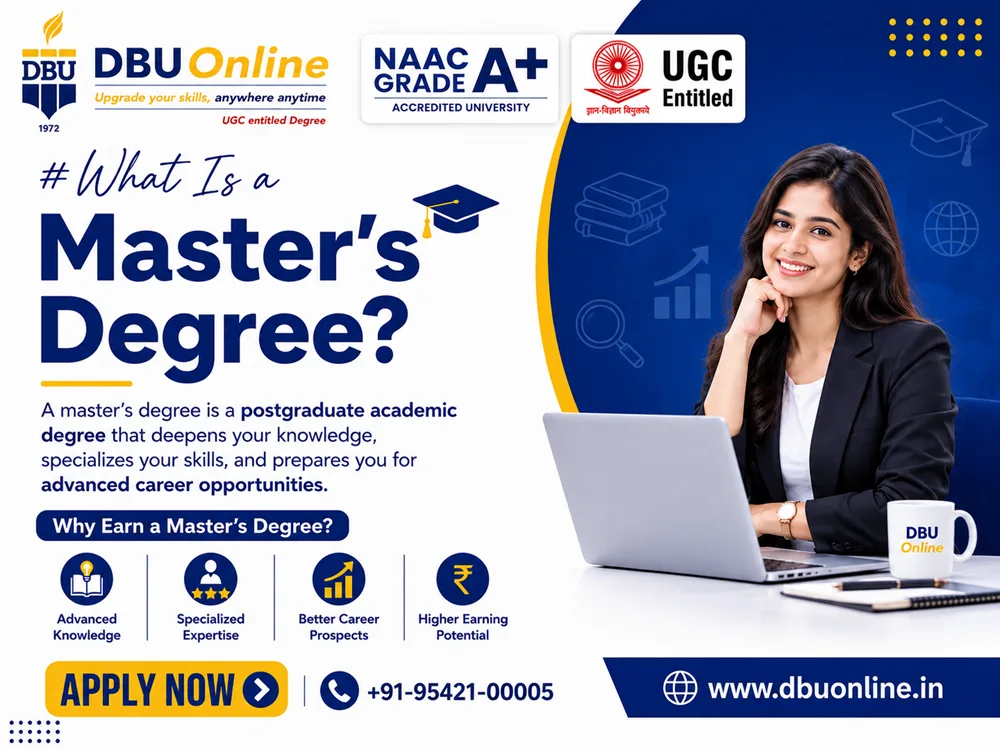
A master's degree is a postgraduate qualification that students can pursue after completing a bachelor's degree. It helps learners gain advanced knowledge in a particular subject or professional field. Many students choose a master's degree to improve their qualifications, learn specialised skills and prepare for better career opportunities.
After completing graduation, students may have different goals. Some want to study business management, while others want to continue in commerce, computer applications, arts, journalism or another subject. A master's degree gives them an opportunity to study their chosen field at a higher academic level.
Today, students can also explore online master's degree programmes. Online education can help graduates continue their studies while managing work, family responsibilities or other commitments. At DBU Online, we offer postgraduate programmes in areas such as management, commerce, computer applications, arts, library science and journalism and mass communication.
A master's degree is a postgraduate academic qualification pursued after a bachelor's degree. It provides advanced knowledge and specialised learning in a chosen subject. Most master's programmes take one or two years to complete, depending on the course and university.
Master's Degree: Key Highlights
Before choosing a master's programme, it is useful to understand its basic details. The following table provides a quick overview.
| Particulars | Details |
|---|---|
| Degree Level | Postgraduate (PG) |
| Basic Eligibility | Completed bachelor's degree from a recognised university |
| Course Duration | Usually 1 or 2 years, depending on the programme |
| Study Areas | Management, Commerce, Arts, Computer Applications, Media and more |
| Common Degree Names | MA, MBA, MCA, M.Com and M.Lib |
| Next Step | Employment, professional development or doctoral studies |
What Is a Master's Degree?
A master's degree is an advanced qualification that students earn after completing an undergraduate degree. It is also known as a postgraduate degree or PG degree. The course allows students to study a subject in greater detail than they usually do during their bachelor's programme.
For example, a student who completes a Bachelor of Commerce (B.Com) may choose to study Master of Commerce (M.Com). A graduate interested in business and management may pursue a Master of Business Administration (MBA). Similarly, a student with a suitable academic background may choose a Master of Computer Applications (MCA).
Each master's programme has its own subjects, learning goals and admission requirements. Some programmes focus on academic knowledge, while others are designed around professional skills and practical applications.
A master's degree may include classroom or online learning, assignments, examinations, projects, research work and presentations. The exact course structure depends on the university and the programme.
What Does the Word Master's Mean?
The word "master's" refers to an advanced level of learning in a particular field. It does not mean that a person has mastered everything about a subject. Instead, it shows that the student has completed a higher level of academic study after graduation.
For example, an MA in English provides advanced learning in literature, language and related subjects. An MBA focuses on business administration and management. An M.Com provides further study in commerce, accounting, finance and related areas.
Why Do Students Pursue a Master's Degree?
Many graduates choose postgraduate education because they want to continue learning and build a stronger academic profile. A bachelor's degree provides a foundation, while a master's degree helps students explore a subject in greater depth.
Here are some common reasons students choose a master's degree:
- Advanced knowledge: Students learn more about their chosen subject and explore topics in greater detail.
- Specialised learning: A master's programme may focus on a particular area, such as finance, marketing, computer applications or English literature.
- Career development: Some professional roles may prefer or require a postgraduate qualification.
- Academic growth: Students who want to pursue research or teaching may need further qualifications, depending on the role and applicable rules.
- Professional development: Working professionals may choose postgraduate education to update their knowledge and strengthen their skills.
- Further studies: A master's degree can provide an academic foundation for applying to a PhD or other advanced programmes, subject to admission requirements.
Types of Master's Degrees
There are different types of master's degrees. Each one is designed for a particular academic area or professional interest. Students should understand the course focus before selecting a programme.
1. Master of Arts (MA)
A Master of Arts is a postgraduate degree in humanities, social sciences, languages and related subjects. It is suitable for graduates who want to develop advanced knowledge in areas such as English, History and Political Science.
Depending on the subject, students may study literature, historical events, political systems, society, language, culture and research methods. An MA can support career paths in education, writing, research, communication and other related fields, subject to the required qualifications.
2. Master of Business Administration (MBA)
A Master of Business Administration is a postgraduate management degree. It helps students understand how organisations operate and how business decisions are made.
MBA subjects may include marketing, finance, human resource management, business communication, operations, economics and strategic management. Students interested in management, business operations, entrepreneurship or corporate roles may consider this programme.
3. Master of Commerce (M.Com)
A Master of Commerce is a postgraduate degree focused on commerce, accounting, finance, economics and business-related subjects. It is generally suitable for graduates from commerce and other relevant academic backgrounds who meet the admission requirements.
Students may study financial management, accounting, taxation, business management, banking, economics and research methods. The programme can support further learning and career development in commerce and finance-related areas.
4. Master of Computer Applications (MCA)
A Master of Computer Applications is a postgraduate programme focused on computer applications and information technology. It is designed for students who want to develop advanced knowledge of computing and software-related subjects.
Depending on the curriculum, topics may include programming, database management, software engineering, computer networks, web technologies and application development. Eligibility requirements can vary according to the student's previous qualification and the university's rules.
5. Master of Library Science (M.Lib)
A Master of Library Science is an advanced programme for students interested in library services, information management and related professional areas. It may cover library organisation, information sources, cataloguing, classification and digital information services.
Students who want to work in libraries, information centres, academic institutions or related organisations may explore this field. The required previous qualification depends on the programme's admission rules.
6. Master of Journalism and Mass Communication (MJMC)
Master of Journalism and Mass Communication is a postgraduate programme for graduates interested in media, journalism and communication. It helps students understand how information is created, presented and shared through different media platforms.
Course topics may include journalism, media studies, communication, reporting, editing, public relations and digital media. It may be suitable for students interested in media organisations, content development, communication and related career areas.
How Many Years Does a Master's Degree Take?
The duration of a master's degree depends on the programme, university regulations and study structure. Many postgraduate programmes in India are designed for two years and divided into four semesters. Some programmes may have a one-year duration.
For example, DBU Online offers several master's programmes with a two-year duration, while its M.Lib programme is listed as a one-year programme. Students should always check the current course details before applying.
| Master's Programme | Common Duration | Semesters at DBU Online |
|---|---|---|
| Master of Business Administration (MBA) | 2 Years | 4 Semesters |
| Master of Computer Applications (MCA) | 2 Years | 4 Semesters |
| Master of Commerce (M.Com) | 2 Years | 4 Semesters |
| Master of Arts (MA) Programmes | 2 Years | 4 Semesters |
| Master of Arts in Journalism and Mass Communication (MJMC) | 2 Years | 4 Semesters |
| Master of Library Science (M.Lib) | 1 Year | 2 Semesters |
What Is a Semester in a Master's Degree?
A semester is a part of an academic year. Universities divide many postgraduate programmes into semesters to organise subjects, assignments and examinations.
For example, a two-year master's programme with four semesters generally has two semesters in each academic year. Students complete the subjects and academic requirements of each semester to progress through the programme.
The number of semesters and the academic calendar may differ between programmes and universities. Therefore, students should review the course structure before admission.
What Is the Eligibility for a Master's Degree?
The basic eligibility requirement for most master's programmes is a completed bachelor's degree from a recognised university. However, the required subject background and minimum marks depend on the course.
Some programmes accept graduates from different streams, while others require a relevant undergraduate qualification. For example, an MBA may accept graduates from different academic backgrounds, whereas an MCA may require a suitable background in computer applications, computer science or mathematics, as specified by the university.
Common Eligibility Requirements
- Students should have completed a bachelor's degree or an equivalent qualification.
- The previous degree should be from a recognised university or institution.
- Applicants should meet the minimum marks or grade requirements of the selected programme.
- Some courses may require a specific subject background.
- Applicants should provide the required academic documents during admission.
How to Get Admission to a Master's Degree Programme?
The admission process depends on the university and the selected course. Many universities offer admission based on a student's graduation qualification and marks. Some programmes may also have additional admission requirements.
Students can generally follow these steps when applying for a master's degree:
- Choose a programme: Select a master's degree based on your previous qualification, subject interest and career goals.
- Check eligibility: Review the course-specific eligibility conditions, minimum marks and required academic background.
- Visit the admission portal: Open the university's official admission portal.
- Complete the application: Enter the required personal and academic information in the application form.
- Upload documents: Submit the required educational certificates, photographs and other documents.
- Complete the fee process: Pay the applicable admission or programme fee through the available payment method.
- Check admission updates: Follow the university's instructions for application review, verification and confirmation.
Applicants should use the official admission portal and check the latest instructions before completing their application.
What Subjects Are Studied in a Master's Degree?
The subjects in a master's programme depend on the chosen specialisation. Students study advanced topics related to their field and may also complete assignments, projects, presentations or research work.
Here are examples of subjects that students may study in different master's programmes:
| Programme | Example Subjects |
|---|---|
| MBA | Marketing Management, Financial Management, Human Resource Management, Business Strategy |
| MCA | Programming, Database Management, Software Engineering, Computer Networks |
| M.Com | Accounting, Financial Management, Business Economics, Taxation |
| MA English | English Literature, Literary Criticism, Language Studies, Research Methods |
| MA History | Ancient History, Medieval History, Modern History, Historical Research |
| MA Political Science | Political Theory, International Relations, Indian Government, Public Administration |
| MJMC | Journalism, Media Studies, Communication, Public Relations, Digital Media |
| M.Lib | Library Management, Information Sources, Cataloguing, Digital Libraries |
These are examples of common learning areas. The actual subjects and semester-wise syllabus depend on the programme curriculum.
What Are the Benefits of a Master's Degree?
A master's degree can help students continue their education after graduation and develop deeper knowledge in a selected subject. It can also help learners prepare for professional roles that require advanced academic qualifications.
1. Better Subject Knowledge
A master's programme gives students more time to understand their chosen field. They study advanced concepts and explore topics that may not have been covered in detail during their bachelor's degree.
2. Specialised Skills
Students can focus on a particular area of study. For example, an MBA student may focus on management and business, while an MCA student may develop knowledge of computing and software applications.
3. More Academic Opportunities
A master's degree can help students meet the academic requirements for further education. Graduates may explore research programmes, professional certifications or doctoral studies, depending on the admission rules.
4. Career Development
Some employers prefer candidates with postgraduate qualifications for specific positions. A master's degree may help graduates apply for roles that require advanced subject knowledge. However, selection also depends on experience, skills and employer requirements.
5. Personal Growth
Postgraduate study can help learners improve their communication, research, problem-solving and time-management skills. These skills can be useful in both professional and personal life.
Career Options After a Master's Degree
Career opportunities after a master's degree depend on the subject, skills, work experience and additional qualifications of the student. Different postgraduate programmes can lead to different career areas.
| Master's Degree | Possible Career Areas |
|---|---|
| MBA | Business Management, Marketing, Human Resources, Finance, Operations |
| MCA | Software Development, IT Services, Database Management, Application Development |
| M.Com | Accounting, Banking, Finance, Taxation, Business Analysis |
| MA English | Writing, Editing, Content Development, Education, Communication |
| MA History | Research, Education, Archives, Museums, Historical Content |
| MA Political Science | Research, Public Policy, Education, Political Analysis, Administration |
| MJMC | Journalism, Media, Public Relations, Content Production, Communication |
| M.Lib | Library Services, Information Management, Documentation, Academic Libraries |
These career areas are examples, not guaranteed job outcomes. Some positions may require additional examinations, professional training, experience or other qualifications.
What Is an Online Master's Degree?
An online master's degree is a postgraduate programme that students study through an online learning system instead of attending a traditional campus classroom for regular lessons. It allows learners to access their course materials and academic resources through digital platforms.
Online education can be useful for graduates who want to continue their studies while managing other responsibilities. Working professionals, recent graduates and learners who need more flexibility may consider online postgraduate programmes.
How Does Online Master's Degree Learning Work?
Online learning generally uses a digital platform to provide academic resources and course-related activities. Depending on the programme, students may use online learning materials, recorded lectures, assignments, assessments and other study resources.
Students are responsible for following the academic schedule, completing assignments and preparing for examinations. Online education offers flexibility, but it still requires regular study and commitment.
Benefits of an Online Master's Degree
- Flexible learning: Students can plan their study time around their daily responsibilities, according to the programme schedule.
- Location flexibility: Learners can access their online studies from different locations with a suitable internet connection.
- Digital study resources: Course materials and other academic resources may be available through an online learning platform.
- Work and study balance: Online learning may help working professionals continue their education while managing employment.
- Choice of programmes: Students can explore postgraduate options in different academic and professional areas.
Master's Degree Programmes Offered at DBU Online
At DBU Online, we provide postgraduate programmes for graduates who want to continue their education through online learning. Our master's programmes cover different fields, including management, computer applications, commerce, arts, library science and journalism and mass communication.
Students can select a programme according to their previous education, academic interests and future plans. The following table provides an overview of our listed master's programmes and their duration.
| Programme | Full Form | Duration |
|---|---|---|
| Online MBA | Master of Business Administration | 2 Years |
| Online MCA | Master of Computer Applications | 2 Years |
| Online M.Com | Master of Commerce | 2 Years |
| Online M.Lib | Master of Library Science | 1 Year |
| Online MJMC | Master of Arts in Journalism & Mass Communication | 2 Years |
| Online MA English | Master of Arts in English | 2 Years |
| Online MA History | Master of Arts in History | 2 Years |
| Online MA Political Science | Master of Arts in Political Science | 2 Years |
Our programmes have different eligibility requirements. For example, the MBA requires a bachelor's degree with the prescribed minimum marks, while the MCA has specific academic background requirements. M.Com and other programmes also have their own admission conditions.
Before applying, students should review the individual programme page for complete information about eligibility, course structure, duration and fees.
Who Can Consider DBU Online Master's Programmes?
- Graduates who want to continue their higher education.
- Working professionals who want to develop their academic qualifications.
- Students interested in management, commerce, computer applications or arts.
- Learners who prefer an online mode of education.
- Graduates planning to explore further academic or professional opportunities.
Explore Master's Degree Programmes at DBU Online
Choose a postgraduate programme that matches your education and career goals. Check the eligibility requirements and admission details before applying.
Apply for AdmissionHow to Choose the Right Master's Degree?
Selecting a master's programme is an important academic decision. Students should not choose a course only because it is popular. The right programme should match their previous education, interests and future plans.
1. Understand Your Interests
Think about the subjects you enjoyed during graduation and the areas you want to study further. If you are interested in business, an MBA may be worth exploring. If you prefer commerce and finance, you may consider M.Com.
2. Check Your Eligibility
Every programme has specific admission requirements. Check the required graduation qualification, minimum marks and subject background before selecting a course.
3. Compare Course Subjects
Review the syllabus and semester-wise subjects. Make sure the programme covers the topics you want to learn and supports your academic interests.
4. Understand the Course Duration
Check the total duration, number of semesters and academic schedule. This can help you plan your studies along with your personal or professional responsibilities.
5. Check the Mode of Learning
Decide whether you prefer regular classroom learning, distance education or online education. If you need location flexibility, an online programme may be a suitable option.
6. Review Fees and Other Requirements
Check the complete fee structure, examination charges and other applicable costs. Also review the admission process and documents required by the university.
Difference Between a Bachelor's Degree and a Master's Degree
A bachelor's degree and a master's degree are two different levels of higher education. A bachelor's degree is an undergraduate qualification, while a master's degree is a postgraduate qualification.
Students generally complete a bachelor's degree first and then apply for a master's programme if they want to continue their education.
| Basis | Bachelor's Degree | Master's Degree |
|---|---|---|
| Education Level | Undergraduate (UG) | Postgraduate (PG) |
| Admission Qualification | Usually Class 12 or equivalent | Usually a bachelor's degree |
| Study Focus | Foundation and core subject knowledge | Advanced and specialised subject knowledge |
| Common Duration | Often 3 or 4 years, depending on the programme | Often 1 or 2 years, depending on the programme |
| Examples | BA, BBA, B.Com, B.Sc | MA, MBA, M.Com, MCA |
| Next Academic Step | Master's degree | Doctoral or other advanced studies |
Difference Between a Master's Degree and a Postgraduate Diploma
A master's degree and a postgraduate diploma are both options for students who have completed graduation. However, they are different qualifications and may have different academic structures.
A master's degree is a postgraduate degree awarded after completing the prescribed academic requirements of a university programme. A postgraduate diploma is a separate qualification that generally focuses on a particular subject or professional area.
| Basis | Master's Degree | Postgraduate Diploma |
|---|---|---|
| Qualification | Postgraduate degree | Postgraduate diploma |
| Study Focus | Advanced academic and subject learning | Focused learning in a selected area |
| Duration | Depends on the degree programme | Depends on the diploma programme |
| Academic Structure | May include semesters, examinations, projects and research | May include modules, assessments and practical learning |
| Further Studies | May meet the academic requirement for doctoral admission | Acceptance depends on the institution and specific rules |
Conclusion
A master's degree is a postgraduate qualification that helps graduates gain advanced knowledge in a selected subject. It is an important option for students who want to continue their education after completing a bachelor's degree and develop specialised academic or professional skills.
There are different types of master's degrees, including MA, MBA, MCA, M.Com, M.Lib and MJMC. Each programme has its own subjects, eligibility requirements and duration. Students should compare these details before selecting a course.
At DBU Online, we offer master's degree programmes in management, computer applications, commerce, arts, library science and journalism and mass communication. Students can explore our postgraduate programmes and select a course according to their academic background and future goals.
Frequently Asked Questions
1. What is a master's degree in simple words?
A master's degree is a postgraduate qualification that students pursue after completing a bachelor's degree. It provides advanced knowledge and specialised learning in a particular subject or professional field.
2. Is a master's degree the same as a postgraduate degree?
Yes. A master's degree is a type of postgraduate degree. It is commonly called a PG degree because students pursue it after completing an undergraduate qualification.
3. How many years does a master's degree take?
The duration depends on the programme and university. Many master's programmes take two years, while some programmes may take one year. For example, DBU Online lists a two-year duration for its MBA, MCA and M.Com programmes and a one-year duration for M.Lib.
4. Can I pursue a master's degree after graduation?
Yes. Students can apply for a master's degree after completing a bachelor's degree from a recognised university. However, they must meet the specific eligibility and subject requirements of their selected programme.
5. What are the different types of master's degrees?
Common types include Master of Arts (MA), Master of Business Administration (MBA), Master of Commerce (M.Com), Master of Computer Applications (MCA), Master of Library Science (M.Lib) and Master of Journalism and Mass Communication (MJMC).
6. Is an online master's degree a good option?
An online master's degree can be a suitable option for students who need flexibility in their studies. It allows learners to access academic resources online and manage their learning along with other responsibilities. Students should check the programme's recognition and applicable requirements before enrolling.
7. What is the difference between a bachelor's and master's degree?
A bachelor's degree is an undergraduate qualification generally pursued after Class 12. A master's degree is a postgraduate qualification pursued after graduation. A master's programme usually provides more advanced and specialised subject knowledge.
8. What is the minimum qualification for a master's degree?
The usual minimum qualification is a bachelor's degree from a recognised university. Some programmes also require a specific subject background and minimum marks. The exact conditions depend on the selected course.
9. Can I pursue a PhD after a master's degree?
Yes. A master's degree can provide the academic foundation for applying to a PhD programme. However, applicants must meet the subject, marks and other admission requirements set by the university and applicable regulations.
10. Which master's degree programmes are available at DBU Online?
DBU Online offers MBA, MCA, M.Com, M.Lib, MJMC, MA English, MA History and MA Political Science programmes. Students can visit the official website to check the latest course details, eligibility and admission information.