What Is a Bachelor's Degree? Meaning, Types & Benefits
Understand the meaning of a bachelor's degree, its different types, course duration, eligibility, benefits and career opportunities. Explore online undergraduate programmes at DBU Online.
Undergraduate Education | Online Degree Programmes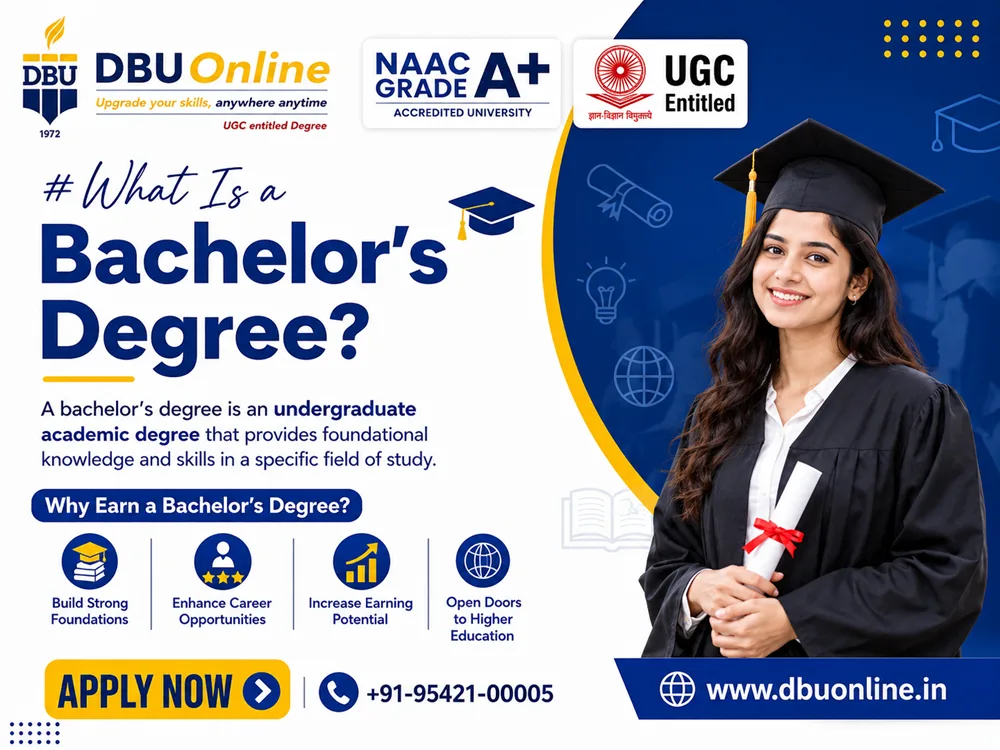
Education plays an important role in building a successful career. After completing Class 12, many students start looking for higher education options. One of the most common choices is a bachelor's degree. It helps students gain knowledge in a particular subject, develop useful skills and prepare for different career opportunities.
A bachelor's degree is an undergraduate qualification that students generally pursue after completing their higher secondary education. It is the first major step towards higher education for students who want to continue their academic journey. Students can choose from different subjects such as business, commerce, arts, science, technology and many other fields.
In this article, we explain what a bachelor's degree is, how it works, its types, duration, eligibility, benefits and career opportunities. We also introduce our undergraduate programmes to help students explore suitable options.
Quick Answer: What Is a Bachelor's Degree?
A bachelor's degree is an undergraduate academic qualification that students generally pursue after completing Class 12 or an equivalent qualification. It provides knowledge and skills in a chosen subject or field of study. Depending on the programme and education system, it usually takes three to four years to complete. Common examples include BA, BBA, B.Com, B.Sc. and B.Tech.
Bachelor's Degree: Highlights
Before selecting an undergraduate programme, students should understand its basic features. Here are some important details about a bachelor's degree.
| Particulars | Details |
|---|---|
| Degree Level | Undergraduate (UG) |
| Entry Qualification | Class 12 or equivalent qualification |
| Course Duration | Generally 3 to 4 years, depending on the programme |
| Study Areas | Arts, Commerce, Business, Science, Technology and others |
| Popular Degrees | BA, BBA, B.Com, B.Sc. and B.Tech |
| Study Modes | Regular, Online and Distance Learning, where offered |
| Next Education Level | Postgraduate (PG) |
What Is a Bachelor's Degree?
A bachelor's degree is a higher education qualification awarded by a recognised university or eligible higher education institution after a student successfully completes an undergraduate programme. It provides a deeper understanding of a chosen subject compared to school-level education.
During a bachelor's degree, students study different subjects related to their selected programme. They attend classes or access learning materials, complete assignments, prepare for examinations and take part in other academic activities as required by their course.
For example, a student interested in business can choose a Bachelor of Business Administration (BBA). Someone interested in accounting and financial subjects can consider a Bachelor of Commerce (B.Com). Students interested in humanities and social sciences can explore a Bachelor of Arts (BA).
A bachelor's degree also helps students prepare for higher education. After completing their undergraduate programme, eligible graduates can apply for postgraduate courses such as MBA, MCA, M.Com and MA, depending on the admission requirements of the selected programme.
Important Point to Remember
A bachelor's degree is not the same as a postgraduate degree. It is generally the first university-level degree after Class 12. A master's degree is a higher academic qualification that students usually pursue after completing a bachelor's degree.
What Is the Meaning of a Bachelor's Degree?
The term bachelor's degree refers to an undergraduate academic qualification awarded after completing a specific course of study at a university. It shows that a student has successfully completed the required academic programme in a particular subject or discipline.
In simple words, when a student completes Class 12 and joins a university-level programme such as BA, BBA or B.Com, they are pursuing a bachelor's degree. After completing all the academic requirements, the university awards the degree.
The word bachelor is used to describe this level of academic qualification. Students from different educational backgrounds can select a bachelor's programme based on their interests, previous studies and future plans.
A bachelor's degree can also be an important qualification for students who want to apply for jobs, competitive examinations or further education. However, the eligibility for each opportunity depends on the specific organisation, examination or course requirements.
What Are the Different Types of Bachelor's Degrees?
There are different types of bachelor's degrees available in higher education. Each degree focuses on a particular academic area. Students should select a programme according to their interests, previous qualifications and career goals.
1. Bachelor of Arts (BA)
Bachelor of Arts is an undergraduate degree that focuses on arts, humanities and social science subjects. Students can study areas such as English, History, Political Science, Sociology, Economics and other related subjects, depending on the programme.
A BA degree is suitable for students interested in understanding society, culture, history, communication and human behaviour. It can also help students prepare for higher education and different career paths.
2. Bachelor of Business Administration (BBA)
Bachelor of Business Administration is an undergraduate programme focused on business and management. Students learn about areas such as marketing, management, finance, business communication, human resources and organisational activities.
BBA is a suitable option for students who want to understand how businesses operate and develop knowledge of management practices. After completing this programme, eligible students can also consider an MBA.
3. Bachelor of Commerce (B.Com)
Bachelor of Commerce is an undergraduate degree related to commerce, accounting, finance and business. It helps students understand financial activities, business operations, taxation, economics and other commerce-related subjects.
Students interested in banking, accounting, finance and business can explore a B.Com programme. After graduation, they can also consider higher studies such as M.Com, MBA and other relevant qualifications.
4. Bachelor of Science (B.Sc.)
Bachelor of Science is an undergraduate degree focused on scientific and technical subjects. Depending on the programme, students can study areas such as Physics, Chemistry, Mathematics, Biology, Computer Science and other scientific disciplines.
It is generally suitable for students who have an interest in science, research, technology and related academic fields. The eligibility requirements depend on the selected subject and university.
5. Bachelor of Technology (B.Tech)
Bachelor of Technology is an undergraduate engineering degree. It focuses on technical knowledge, engineering principles and practical applications. Common specialisations include Computer Science, Mechanical Engineering, Civil Engineering and Electrical Engineering.
Students interested in engineering and technology can consider this degree. Admission requirements normally include specific subjects and other conditions set by the university or applicable admission authority.
| Degree | Full Form | Main Study Area |
|---|---|---|
| BA | Bachelor of Arts | Arts and Humanities |
| BBA | Bachelor of Business Administration | Business and Management |
| B.Com | Bachelor of Commerce | Commerce and Accounting |
| B.Sc. | Bachelor of Science | Science and Technology |
| B.Tech | Bachelor of Technology | Engineering and Technology |
How Many Years Does It Take to Complete a Bachelor's Degree?
The duration of a bachelor's degree depends on the selected programme, university and applicable academic structure. Many undergraduate programmes in India have a duration of three years, while some programmes have a four-year structure.
Students generally study their subjects through semesters. Each semester includes academic activities such as classes, assignments, internal assessments and examinations. The exact structure depends on the university and programme.
At DBU Online, our BA, BBA and B.Com programmes have a duration of three years, divided into six semesters.
| Programme | Duration | Semesters |
|---|---|---|
| Online BA | 3 Years | 6 |
| Online BBA | 3 Years | 6 |
| Online B.Com | 3 Years | 6 |
What Is the Eligibility for a Bachelor's Degree?
Students who want to pursue a bachelor's degree generally need to complete Class 12 or an equivalent qualification from a recognised board. However, the eligibility requirements can differ according to the programme and university.
Some programmes accept students from any stream, while others may require specific subjects or minimum marks. Students should always check the eligibility criteria before applying.
Basic Eligibility Requirements
- Students should have completed Class 12 or an equivalent qualification.
- The previous qualification should be from a recognised board or institution.
- Students must meet the minimum marks required for the selected programme.
- Some programmes may have specific subject requirements.
- Students should submit the required academic documents during admission.
Eligibility for Online Bachelor's Programmes at DBU Online
We provide three undergraduate programmes through DBU Online. Here is a simple overview of their eligibility requirements.
| Programme | Basic Eligibility | Duration |
|---|---|---|
| BBA | 10+2 pass or equivalent in any stream from a recognised board | 3 Years |
| B.Com | 10+2 in any stream with 45% marks (40% for reserved categories as per applicable norms) | 3 Years |
| BA | 10+2 with 45% aggregate marks for general category and 40% for SC/ST/OBC categories | 3 Years |
Students should check the latest programme-specific admission conditions on our official website before submitting an application.
What Is an Online Bachelor's Degree?
An online bachelor's degree is an undergraduate programme delivered through an online learning system. Students can access their academic resources, study materials and other learning activities through digital platforms instead of attending a traditional classroom for everyday learning.
Online education can be useful for students who want to continue their studies while managing work, family responsibilities or other activities. It gives learners an opportunity to study through digital resources and follow the academic schedule provided by their university.
Online programmes generally include different academic activities, such as:
- Online access to study materials and learning resources.
- Recorded or live learning sessions, where provided.
- Assignments and academic assessments.
- Online academic communication and learner support.
- Examinations according to university guidelines.
At DBU Online, we provide undergraduate programmes through an online learning format. Students can explore our BA, BBA and B.Com programmes and select an option that matches their academic interests.
Bachelor's Degree Courses Offered at DBU Online
At DBU Online, we offer undergraduate programmes for students who want to continue their education after Class 12. Our bachelor's degree programmes cover arts, business administration and commerce.
Each programme has a different academic focus. Students can select a course according to their interests, educational background and future career plans.
Online BA
Bachelor of Arts
Duration: 3 Years / 6 Semesters
A programme for students interested in humanities, social sciences and related academic subjects.
Explore BA Programme →Online BBA
Bachelor of Business Administration
Duration: 3 Years / 6 Semesters
A programme for students interested in business, management and organisational activities.
Explore BBA Programme →Online B.Com
Bachelor of Commerce
Duration: 3 Years / 6 Semesters
A programme for students interested in commerce, accounting, finance and business.
Explore B.Com Programme →1. Online Bachelor of Arts (BA)
Our online Bachelor of Arts programme is designed for students who want to study arts and related academic subjects. It provides an opportunity to develop knowledge in humanities and social science areas.
Students can study subjects such as English, History, Political Science, Sociology and other areas included in the programme curriculum.
The programme has a duration of three years and is divided into six semesters. Students who have completed 10+2 can explore this programme if they meet the applicable eligibility requirements.
After completing a BA degree, graduates can explore different career areas, competitive examinations and postgraduate programmes, depending on their qualifications and interests.
2. Online Bachelor of Business Administration (BBA)
Our online Bachelor of Business Administration programme is suitable for students who want to understand business and management. It introduces students to different areas of business operations and management practices.
The programme helps students develop knowledge of management, marketing, business communication, finance and other related areas covered in the curriculum.
The duration of our online BBA programme is three years, divided into six semesters. Students who have passed 10+2 or an equivalent examination in any stream from a recognised board can explore the programme.
After completing BBA, graduates can explore entry-level business roles or continue their education through postgraduate programmes such as MBA, subject to eligibility.
3. Online Bachelor of Commerce (B.Com)
Our online Bachelor of Commerce programme is designed for students interested in commerce, accounting and financial subjects. It provides a foundation in business and commerce-related areas.
Students can develop knowledge of accounting, business, economics, finance and other subjects included in the programme curriculum.
The programme takes three years to complete and includes six semesters. Students who have completed 10+2 in any stream with the required marks can explore admission.
After completing B.Com, graduates can consider opportunities in accounting, finance, banking, business and further education such as M.Com or MBA, depending on the relevant eligibility requirements.
What Are the Benefits of a Bachelor's Degree?
A bachelor's degree can provide several academic and professional benefits. It helps students build a foundation in their chosen subject and prepare for future opportunities.
1. Builds Subject Knowledge
A bachelor's programme helps students understand a particular subject in greater detail. They learn important concepts, theories and practical applications related to their chosen field.
2. Develops Useful Skills
Students can develop communication, problem-solving, research, critical thinking and time management skills during their studies. These skills can be useful in both professional and personal life.
3. Creates Career Opportunities
A bachelor's degree can help students meet the educational requirements for many entry-level positions. The career options depend on the selected subject, knowledge, skills and employer requirements.
4. Supports Higher Education
After completing a bachelor's degree, students can explore postgraduate programmes such as MBA, MCA, M.Com and MA, depending on their previous qualification and the eligibility conditions of the selected course.
5. Offers Different Learning Options
Students can choose from different study modes, including regular, online and distance education, wherever the programme is offered and appropriately recognised. This provides different ways to continue higher education.
6. Helps Build Professional Confidence
Completing a university-level programme can help students improve their subject knowledge and confidence. It also gives them an opportunity to understand their interests and prepare for future academic or career decisions.
Career Opportunities After a Bachelor's Degree
Career opportunities after a bachelor's degree depend on the subject, skills, experience and additional qualifications of a student. Different undergraduate programmes can prepare students for different professional fields.
For example, graduates from arts, business and commerce backgrounds can explore different career options based on their interests and abilities.
| Degree | Possible Career Areas |
|---|---|
| BA | Education, Administration, Journalism, Content Writing and Social Services |
| BBA | Business Operations, Marketing, Sales, Human Resources and Administration |
| B.Com | Accounting, Banking, Finance, Taxation and Business Operations |
| B.Sc. | Science, Research Support, Laboratory Work and Technical Fields |
| B.Tech | Engineering, Technology, Software and Technical Industries |
Students should remember that a degree alone does not guarantee a particular job or salary. Employers may also consider practical knowledge, communication skills, work experience and other professional qualifications.
What Can You Study After Completing a Bachelor's Degree?
After completing a bachelor's degree, students can continue their education through postgraduate programmes. The selected course should match their previous academic qualification and the admission requirements of the university.
At DBU Online, we offer different postgraduate programmes for graduates who want to continue their studies.
| Postgraduate Programme | Full Form | Duration |
|---|---|---|
| MBA | Master of Business Administration | 2 Years |
| MCA | Master of Computer Applications | 2 Years |
| M.Com | Master of Commerce | 2 Years |
| M.Lib | Master of Library Science | 1 Year |
| MJMC | Master of Journalism and Mass Communication | 2 Years |
| MA English | Master of Arts in English | 2 Years |
| MA History | Master of Arts in History | 2 Years |
| MA Political Science | Master of Arts in Political Science | 2 Years |
These programmes provide different study options for graduates. Eligibility and admission requirements vary according to the selected postgraduate programme.
How to Apply for a Bachelor's Degree at DBU Online?
Students interested in our online undergraduate programmes can visit the official DBU Online admission portal to begin their application process. Before applying, we recommend checking the programme details, eligibility conditions and other admission information.
- Explore Our Programmes: Visit the DBU Online website and explore our BA, BBA and B.Com programmes.
- Check Eligibility: Review the educational qualifications and minimum marks required for the selected programme.
- Visit the Admission Portal: Open our official admission portal to start your application.
- Complete the Application: Enter your personal and academic information in the application form.
- Submit Required Documents: Upload or provide the documents requested during the admission process.
- Complete Admission Formalities: Follow the instructions provided by our admission team for verification and fee payment.
Start Your Bachelor's Degree Journey with DBU Online
Explore our online BA, BBA and B.Com programmes. Choose a course that matches your interests and take the next step towards higher education with DBU Online.
Apply NowHow to Choose the Right Bachelor's Degree?
Selecting the right bachelor's degree is an important decision because it can influence your future education and career plans. Students should understand their interests and compare different programmes before making a final choice.
Here are some useful points to consider when selecting an undergraduate programme.
- Understand Your Interests: Choose a subject that you enjoy studying and want to understand in greater detail.
- Check Your Previous Subjects: Some programmes require specific subjects or educational backgrounds. Review these requirements before applying.
- Understand the Course Structure: Check the subjects, duration, semesters and academic activities included in the programme.
- Consider Future Education: Think about whether you may want to pursue a master's degree or another professional qualification after graduation.
- Choose the Right Study Mode: Compare regular, online and distance learning options according to your requirements.
- Check University Recognition: Make sure the university and selected programme meet the applicable recognition and regulatory requirements.
Why Choose DBU Online for a Bachelor's Degree?
At DBU Online, we provide undergraduate programmes for students who want to continue their higher education through online learning. We aim to make academic opportunities accessible to learners with different educational backgrounds.
Students can explore our BA, BBA and B.Com programmes according to their academic interests and future plans.
- UGC-Entitled Online Programmes: We offer online programmes under the applicable UGC entitlement framework.
- Different Undergraduate Options: We offer BA, BBA and B.Com programmes for students interested in arts, business and commerce.
- Online Learning Format: Our online learning system supports students in accessing academic resources through digital platforms.
- Semester-Based Education: Our bachelor's degree programmes follow a six-semester academic structure over three years.
- Postgraduate Study Options: We also offer postgraduate programmes for eligible graduates who want to continue their higher education.
- Learner Support: We provide learner support to help students during their academic journey.
Our goal is to help students explore suitable online education opportunities and make informed decisions about their academic future.
Conclusion
A bachelor's degree is an undergraduate academic qualification that students generally pursue after completing Class 12. It helps learners gain knowledge in a selected subject, develop useful skills and prepare for further education or career opportunities.
There are different types of bachelor's degrees, including BA, BBA, B.Com, B.Sc. and B.Tech. Each programme focuses on a different academic area and has its own eligibility requirements, course structure and duration.
At DBU Online, we offer three online undergraduate programmes: Bachelor of Arts (BA), Bachelor of Business Administration (BBA) and Bachelor of Commerce (B.Com). Each programme has a duration of three years and six semesters.
Students should select their bachelor's degree after considering their interests, previous qualifications and future goals. We encourage learners to explore our undergraduate programmes and review the admission requirements before applying.
Explore online education opportunities with DBU Online and take the next step towards your academic goals.
Frequently Asked Questions (FAQs)
Here are answers to some common questions about bachelor's degrees, undergraduate courses, eligibility and online education.
1. What is a bachelor's degree in simple words?
A bachelor's degree is an undergraduate qualification that students generally pursue after completing Class 12. It provides knowledge and skills in a selected subject or field of study.
2. Is a bachelor's degree the same as an undergraduate degree?
Yes. A bachelor's degree is an undergraduate degree. It is generally the first university-level degree that students pursue after completing higher secondary education.
3. Can I do a bachelor's degree after 12th?
Yes. Students who have completed Class 12 or an equivalent qualification can apply for bachelor's degree programmes. They must meet the eligibility requirements of the selected university and course.
4. How many years does a bachelor's degree take?
A bachelor's degree generally takes three to four years, depending on the programme and academic structure. At DBU Online, our BA, BBA and B.Com programmes have a duration of three years or six semesters.
5. What are the different types of bachelor's degrees?
Common types of bachelor's degrees include BA (Bachelor of Arts), BBA (Bachelor of Business Administration), B.Com (Bachelor of Commerce), B.Sc. (Bachelor of Science) and B.Tech (Bachelor of Technology).
6. What bachelor's degree courses does DBU Online offer?
We offer three online undergraduate programmes: Bachelor of Arts (BA), Bachelor of Business Administration (BBA) and Bachelor of Commerce (B.Com). Each programme has a duration of three years and six semesters.
7. Can I pursue a bachelor's degree online?
Yes. Students can pursue an online bachelor's degree from a university that offers the programme under the applicable regulatory framework. At DBU Online, we provide online BA, BBA and B.Com programmes.
8. What is the difference between a bachelor's degree and a master's degree?
A bachelor's degree is an undergraduate qualification generally pursued after Class 12. A master's degree is a postgraduate qualification that students usually pursue after completing a bachelor's degree.
9. What can I study after completing a bachelor's degree?
After completing a bachelor's degree, eligible students can explore postgraduate programmes such as MBA, MCA, M.Com, MA and other relevant master's courses. The choice depends on their previous qualification and the admission requirements of the selected programme.
10. Is a bachelor's degree useful for career opportunities?
Yes. A bachelor's degree can help students meet the educational requirements for different entry-level jobs and further education. Career opportunities depend on the selected subject, skills, experience and employer requirements.